
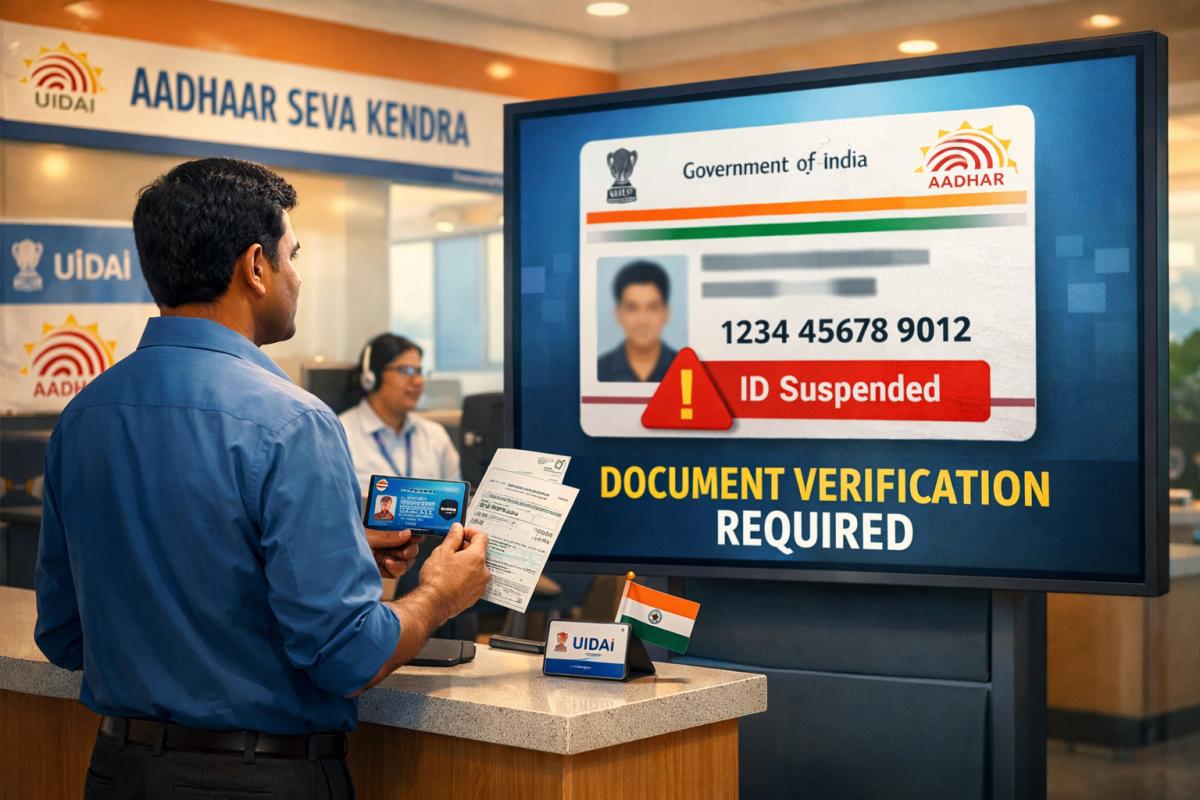

Aadhaar Suspended Due to Document Issues: What It Means, Why It Happens, and How to Fix It
India’s Aadhaar system has become the backbone of digital identity verification across banking, telecom, taxation, welfare schemes, and countless public and private services. From opening a bank account to receiving LPG subsidies or filing income tax returns, Aadhaar plays a foundational role in authentication and eligibility validation. That is why receiving a message stating:
“Your Aadhaar has been suspended due to problem in Documents. Please visit center with valid document to update. List of center available on www.UIDAI.gov.in”
can be alarming for any resident.
This blog provides a comprehensive technical and procedural breakdown of what Aadhaar suspension actually means, the regulatory and data-validation reasons behind it, and the exact remediation workflow you must follow to restore full operational status to your Aadhaar number.
Understanding Aadhaar Suspension: Is Your Aadhaar Really “Blocked”?
First and foremost, it is important to clarify terminology. The Unique Identification Authority of India (UIDAI) does not casually “deactivate” or “cancel” Aadhaar numbers without due cause. However, in specific scenarios, Aadhaar numbers may be temporarily suspended or placed under restricted status due to:
- Demographic data mismatch
- Invalid or unverifiable supporting documents
- Biometric authentication failure patterns
- Suspected duplication
- Document fraud risk signals
- Incomplete KYC during enrollment or update
- Data inconsistency across UIDAI’s Central Identities Data Repository (CIDR)
In most such cases, your Aadhaar is not permanently cancelled — instead, its authentication capability is limited until document revalidation is completed.
This restricted state can result in:
- Failed OTP authentication
- Rejected biometric verification
- Inability to link Aadhaar with bank accounts
- eKYC failure for SIM cards
- Rejection of government subsidy enrollment
- PAN-Aadhaar linking errors
- UPI onboarding issues
- DigiLocker or EPFO service disruptions
Common Causes of Aadhaar Suspension Due to Document Problems
1. Invalid Proof of Identity (POI)
If the submitted identity document during Aadhaar enrollment or update (such as PAN Card, Passport, or Voter ID) is:
- Expired
- Illegible
- Mismatched in name spelling
- Forged or tampered
then UIDAI’s backend validation engine may mark your profile for review.
2. Address Verification Failure (POA)
If your address proof fails validation — for instance:
- Utility bills older than 3 months
- Bank statements without official stamp
- Rental agreements without legal registration
then Aadhaar authentication tied to geographic eligibility (e.g., state subsidies) may be restricted.
3. Date of Birth Mismatch
UIDAI enforces strict consistency in Date of Birth (DOB) across official records. A mismatch between:
- Aadhaar DOB
- PAN database
- Passport records
- School certificates
can trigger KYC conflict flags.
4. Biometric Exception Cases
In certain situations, biometric data (fingerprint or iris) may degrade over time due to:
- Aging
- Manual labor impact
- Injury or medical conditions
Repeated biometric authentication failure can initiate a document revalidation request.
5. Multiple Aadhaar Enrollments
UIDAI prohibits duplication. If system-level checks identify:
- Similar biometric signatures
- Identical demographic clusters
then one or more Aadhaar numbers may be suspended pending investigation.
UIDAI’s Compliance and Data Integrity Mandate
UIDAI must adhere to strict national and cybersecurity frameworks under:
- The Aadhaar Act, 2016
- Information Technology Act, 2000
- Data privacy and identity assurance protocols
In order to prevent:
- Identity theft
- Subsidy leakage
- Financial fraud
- SIM card misuse
- Tax evasion through fake identity
UIDAI uses automated and manual audit pipelines to periodically assess identity record validity. If your submitted documents fail validation checks against issuing authorities, a temporary suspension notice may be issued.
How to Confirm If Your Aadhaar Is Suspended
Before taking corrective action, you should verify the actual status of your Aadhaar number.
You may experience:
- OTP not being delivered
- Authentication declined during bank KYC
- UIDAI portal showing update required
- SMS notification from UIDAI
You can also:
- Visit the UIDAI official website
- Use the “Verify Aadhaar Number” feature
- Check Authentication History
- Contact UIDAI Helpline 1947
Step-by-Step Process to Reactivate Suspended Aadhaar
Step 1: Collect Valid Supporting Documents
Ensure you carry original copies of the following:
| Type | Documents |
|---|---|
| Proof of Identity (POI) | Passport, PAN Card, Voter ID, Driving License, Government Photo ID |
| Proof of Address (POA) | Electricity Bill (recent), Bank Statement (last 3 months), Ration Card, Registered Rent Agreement, Passport |
| Proof of Date of Birth (DOB) | Birth Certificate, SSLC Certificate, Passport |
Step 2: Locate Nearest Aadhaar Seva Kendra
- Capture biometric updates
- Scan and upload documents
- Perform demographic correction
- Submit reactivation request
Step 3: Submit Aadhaar Update Request
- Fill the Aadhaar Update/Correction Form
- Select the fields to be updated
- Provide valid documentation
- Complete biometric authentication
- Review data entered by operator
A nominal update fee may be charged.
Step 4: Collect Update Request Number (URN)
Once submitted, you will receive:
- Acknowledgement slip
- Update Request Number (URN)
Use this URN to track update status online.
Step 5: Track Update Status
Updates typically take:
- 5 to 10 working days for demographic data
- Up to 15 days for biometric updates
Important Security Warning: Beware of Fraudulent SMS
Many scammers send fake messages impersonating UIDAI. Genuine UIDAI messages:
- Do not contain suspicious links
- Do not ask for OTP or PIN
- Do not request payment via unofficial platforms
Always verify URLs before visiting. UIDAI’s official domain is:
https://uidai.gov.in
Do not share Aadhaar details with:
- Unknown callers
- WhatsApp agents
- Email attachments
- Unverified mobile apps
Consequences of Not Updating Suspended Aadhaar
- Bank account freezing
- PAN-Aadhaar delinking
- Rejection of government benefits
- SIM deactivation
- eKYC failure
- UPI payment onboarding errors
- Passport application delays
Preventive Measures for the Future
- Ensure document consistency across databases
- Update Aadhaar after address change
- Revalidate biometrics every 5–10 years
- Use official UIDAI channels for updates
- Avoid multiple enrollment attempts
- Monitor authentication history periodically
Conclusion
Aadhaar suspension due to document problems is not uncommon and is typically a reversible compliance action rather than a permanent cancellation. It serves as a protective mechanism to ensure that identity records remain accurate, verifiable, and fraud-resistant within India’s digital governance framework. By promptly visiting an authorized Aadhaar Seva Kendra with valid documents and completing the update process, residents can quickly restore full functionality to their Aadhaar number. Staying vigilant against fraudulent messages and maintaining up-to-date demographic and biometric information will help ensure uninterrupted access to financial, telecom, and government services linked to Aadhaar in the future.


Community Insights